
Key findings from three research phases and suggestions for future action
This research paper reviews the implementation of Upskilling Pathways in Croatia, focusing on opportunities for adults with low skills and qualifications to access learning and improve their employability. It analyses Croatia’s adult learning policies, governance structures, funding mechanisms, and support measures, with particular attention to the implementation of the Adult Education Act, the voucher scheme for skills development, and coordination among key stakeholders. The publication identifies achievements and challenges in reaching vulnerable groups, strengthening lifelong learning participation, and ensuring sustainable access to training opportunities. Based on evidence gathered through a thematic country review, it offers recommendations for improving the effectiveness, inclusiveness, and long-term sustainability of adult upskilling policies in Croatia.
Croatia
The Spotlights provide insights into the current labour market landscape, future trends, and skills anticipation in each country. The analysis is based on Cedefop’s skills intelligence online tool, its skills forecast, the European Skills Index (ESI), online job advertisements, sectoral and occupational skills intelligence, and country-specific skills anticipation reports.
Key findings of the first research phase
This report presents the findings from the first (micro) phase of the thematic country review (TCR) on upskilling pathways (UP) in Croatia. The TCR on UP in Croatia focuses on key areas such as multilevel and multi-stakeholder governance, the provision of financial and non-financial support, and the strategies for outreach towards beneficiaries. Cedefop’s TCRs on UP aim at supporting EU Member States in developing systematic, coordinated and coherent approaches to upskilling pathways for low-skilled adults. These in-depth reviews assess national approaches for implementing the recommendation on upskilling pathways, with the support of key national stakeholders.
Croatia
This VET policy brief produced by Cedefop presents a snapshot of vocational education and training policy developments in Croatia between 2020 and the end of 2024. It presents the context and the challenges the country faces, a selection of the latest VET-related statistics, as well as the national priorities until 2030 identified in Croatia’s national implementation plan. This policy brief provides information from Cedefop monitoring and analysis on the implementation of the Council Recommendation on VET and Osnabrück Declaration and contributes to shaping new EU priorities in VET as of 2026 and informing the mid-term evaluation of the Council Recommendation on VET.
Croatia
This report provides an updated overview of the Croatian Qualifications Framework (CROQF) and its development as a comprehensive framework covering general education, vocational education and training (VET), higher education, and adult learning. It examines the framework’s objectives, legal basis, level structure, learning-outcomes approach, quality assurance arrangements, and governance mechanisms. The publication also analyses recent progress in the recognition and validation of prior learning, the recognition of foreign qualifications, and the implementation and impact of the CROQF within the national education and labour market systems. By highlighting key developments since the previous reporting cycle, including the updated referencing to the European Qualifications Framework (EQF), the report demonstrates how the CROQF supports transparency, lifelong learning, qualification relevance, and skills matching in Croatia.
Croatia
This report presents Cedefop’s projections of future labour market and skills trends in Croatia up to 2035. It analyses expected developments in employment, labour force participation, sectoral growth, occupational change, and qualifications demand, providing evidence on how demographic shifts, economic developments, and technological transformation will shape future skills needs. The publication examines job creation and replacement demand across sectors and occupations, highlights potential skills shortages and imbalances, and assesses the evolving demand for different qualification levels.
Making national VET agile, flexible, innovative, attractive, inclusive and quality-assured
Based on developments during 2023, the publication analyses national reforms and initiatives aimed at strengthening the responsiveness of VET to labour market needs, expanding lifelong learning opportunities, supporting digitalisation and innovation, and promoting equal access to quality education and training. The report also examines quality assurance mechanisms and stakeholder involvement in implementing national VET policies aligned with the Council Recommendation on VET and the Osnabrück Declaration. By highlighting achievements, challenges, and future priorities, it provides a comprehensive overview of Croatia’s efforts to modernise and strengthen its VET system in line with European policy objectives.
Croatia
This VET policy brief produced by Cedefop presents a snapshot of vocational education and training policy developments in Croatia between 2020 and the beginning of 2023. It presents the context and the challenges the country faces, a selection of the latest VET-related statistics, as well as the national priorities until 2030 identified in Croatia’s national implementation plan. This VET policy brief provides information from Cedefop monitoring and analysis on the implementation of the Council Recommendation on VET and Osnabrück Declaration. It offers stakeholders a regular source of information on VET policy developments that could be used for future policy making.
Country report - Croatia
This report provides an overview of vocational education and training (VET) developments in Croatia in 2023, presenting key policy initiatives, reforms, and trends shaping the national skills and qualifications system. It examines developments across initial and continuing VET, work-based learning, qualifications, lifelong learning, and skills governance, while placing these within the broader context of labour market needs and European policy priorities. The publication highlights progress in modernising curricula, strengthening links between education and employers, supporting digital and green transitions, and improving the quality and attractiveness of VET. It also discusses remaining challenges and outlines policy directions aimed at enhancing the responsiveness, inclusiveness, and effectiveness of Croatia’s education and training system.
Croatia
The report provides an overview of the Croatian Qualifications Framework (CROQF) and its development within the broader European Qualifications Framework (EQF) context. It examines the framework’s objectives, governance arrangements, level structure, and the role of learning outcomes in the design and classification of qualifications. The publication analyses the implementation and impact of the CROQF, including quality assurance mechanisms, stakeholder involvement, recognition of prior learning, and the validation of non-formal and informal learning. It also reviews progress in increasing transparency and comparability of qualifications, highlighting the framework’s contribution to lifelong learning, labour market relevance, and mobility within Croatia and across Europe.
Croatia
The skill forecast country reports summarise key future trends in jobs and skills for individual EU Member States. They offer a concise outlook on national employment trends by sector, occupational group and education level, as well as developments in the working age population by age and gender. Implications for future labour market imbalances can be identified when demand and supply are looked at together. A common methodology and harmonised data ensure comparability of results across Member States. The estimations are consistent with official EU economic forecasts and population projections.
Case study: Croatia
This report describes how entrepreneurship competence is embedded in vocational education and training (VET) in Croatia. It complements existing knowledge with examples of methods, tools and approaches that can help policy-makers, VET providers and other stakeholders build better entrepreneurial learning ecosystems.
Building up competences for inclusive, green and digitalised vocational education and training - Croatia
This report examines the role of VET teachers and trainers in Croatia in the context of digitalisation, the green transition, and the growing need for inclusive education. It provides an overview of the profiles, responsibilities, and professional development opportunities of VET teachers and trainers in both school-based and work-based learning environments. The publication analyses national policies, reforms, and initiatives aimed at strengthening their competences. It also highlights key challenges, including teacher shortages, an ageing workforce, the attractiveness of the profession, and the need for stronger links between education and labour market demands. Drawing on recent developments and policy measures, the report identifies priorities for supporting teachers and trainers as central actors in ensuring high-quality and future-oriented VET in Croatia. Publication is available at: https://cumulus.cedefop.europa.eu/files/vetelib/2022/teachers_and_trainers_in_a_changing_world_Croatia_Cedefop_ReferNet.pdf
Croatia
The inventory provides an overview of the Croatian Qualifications Framework (CROQF) and its role in supporting transparency, quality, and lifelong learning within the national education and training system. It examines the framework’s policy objectives, level structure, learning-outcomes approach, governance arrangements, and links to the European Qualifications Framework (EQF). The publication also discusses the recognition and validation of non-formal and informal learning, stakeholder involvement, and the implementation progress of the CROQF. By highlighting achievements, challenges, and future priorities, the report demonstrates how the qualifications framework contributes to improving the relevance, comparability, and labour market responsiveness of qualifications in Croatia.
Croatia
This publication is a country-specific report accompanying the latest release of Cedefop’s skills forecast. The report covers a period some 10 to 15 years ahead and offers an estimate of the expected developments in a country’s labour market, bringing together key trends identified. Specifically, the report provides a general overview of employment and labour force developments, employment trends for different sectors, and a detailed breakdown of future job openings in different occupations. The differences between the future needs in skills demand and the forecasted supply are also analysed.
Croatia
This report describes developments in vocational education and training (VET) since 2015 policy in the EU Member States, Iceland and Norway. It is part of the series Cedefop monitoring and analysis of VET policies and consist the background material for the Cedefop 2020 and 2018 analysis on the progress towards achieving targets that have been agreed within the process of European cooperation in VET since 2015. This country report is based on information collected from Cedefopʼs European network of expertise on VET (ReferNet), the Directors General for Vocational Education and Training and other sources.
Croatia
Vocational Education and Training for the Future of Work examines how Croatia’s vocational education and training (VET) system is adapting to the changing world of work. It analyses key trends affecting skills demand, employment, technological development, and demographic change, and discusses the capacity of the Croatian VET system to respond to future labour market needs. The publication reviews ongoing reforms, governance arrangements, work-based learning, and stakeholder involvement, highlighting both achievements and remaining challenges in ensuring that VET learners acquire relevant skills for sustainable employment. It also identifies policy directions to strengthen the responsiveness, quality, and attractiveness of VET in Croatia in the context of economic and technological transformation. Publication is available at: https://cumulus.cedefop.europa.eu/files/vetelib/2020/vocational_education_training_future_work_Croatia_Cedefop_ReferNet.pdf
Short description
This short description contributes to a better understanding of vocational education and training (VET) in Croatia by providing insights into its main features and highlighting system developments and current challenges in recent years. The Croatian presidency of the Council of the EU in the first half of 2020 focuses on teachers and trainers who are at the heart of all developmental and reform processes, as promoters and enablers of the new skills needed for the future.
Croatia
Vocational education and training (VET) plays a prominent role in Croatia. Overall responsibility for VET lies with the Ministry of Science and Education supported by the Agency for VET and Adult Education (ASOO). Cedefop's brief guide provides all the information you need on Croatia's VET system in a concise manner.
Focus on long-term mobility: Croatia
The article discusses the enablers and the disablers for long-term international mobility of apprentices in Croatia, both inbound and outbound. In particular, the article analyses different aspects of exogenous factors influencing the mobility of apprentices at the upper secondary level, the link between the apprenticeship scheme design and the apprentices’ mobility, as well as lessons learnt from the existing policies and initiatives of apprentices’ mobility.
Country report: Croatia
Since 2013, when the Act on the Croatian Qualification Framework (CROQF) was
established, validation is being incorporated in many strategic documents which
would imply that on a system level, validation has gained in significance. The
developments in the last five years are slowly, but steadily, setting the scene for the
development of the validation framework.
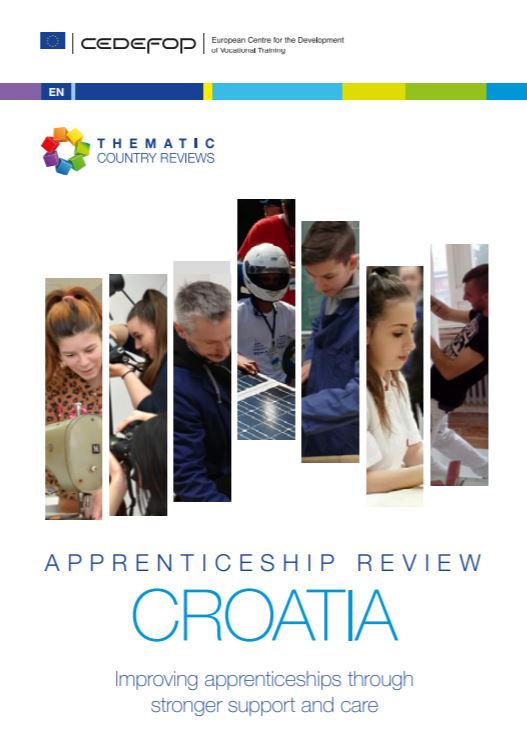
Improving apprenticeships through stronger support and care
This publication is the final report of Cedefop’s thematic country review of apprenticeship in Croatia. The review took place between January 2017 and June 2018 at the request of the Ministry of Science and Education of Croatia. It examined the unified model of education (jedinstveni model obrazovanja) three-year programmes for trades and crafts (CROQF level 4.1). The report presents key findings and suggestions for action to improve and further develop the model in line with the curriculum reform and labour market needs.
Croatia - European inventory on NQF 2018
Cedefop’s forecasts use harmonised international data and a common methodological approach allowing cross-country comparisons about employment trends in sectors, occupations and qualifications. The latest round of forecasts covers the period up to 2030.
National article analysing the results of the Opinion survey on vocational education and training in Europe. Launched in 2016 by Cedefop, the Opinion survey provides data on European citizens’ opinions on awareness, attractiveness and effectiveness of vocational education and training in Europe.
The national reports developed by ReferNet partners reflect efforts done by
Member States to reach vulnerable groups affected by unemployment and
inactivity and help them reengage in learning and employment. The reports refer,
in particular, to measures which may include young adults not in employment,
education or training (NEET) and adults undergoing long term unemployment
(LTU), given their persistence in many countries and the high challenges these
groups face.
Cedefop monitoring and analysis of VET policies in Croatia from 2015-17
Croatia
This VET in Europe report is part of a series prepared by Cedefop’s ReferNet network. VET in Europe reports provide an overview of national vocational education and training (VET) systems of the EU Member States, Iceland and Norway.
VET in Croatia
Vocational education and training (VET) plays a major role in Croatia. Overall responsibility for VET lies with the Ministry of Science and Education supported by the Agency for VET and Adult Education (ASOO). The agency is responsible for developing VET curricula, continuous professional development of VET teachers, skills competitions and quality assurance.
Europska mreža za razmjenu znanja
ReferNet-ov rad na prikupljanju i praćenju EN informacija o nacionalnom strukovnom obrazovanju i osposobljavanju provodi se na raznovrsne načine...
Croatia
Croatia is a parliamentary democracy and is organised as a unitary republic since 1991, when it declared its independence. The political system of Croatia is based on the principle of the division of power between the legislative, executive and judicial branches.
Croatia
In Croatian Vocational Education and Training system there is an apprenticeship scheme that is implemented from the school year 2004-2005 and only in three-year vocational education and training program for crafts, commonly known as Unified Model of Education (UME).
Croatia
VET system in Republic of Croatia has been going through many changes, modernisations and innovations in last several years. Agency for VET and Adult Education (AVETAE) with support of the Ministry of Science, Education and Sport (MoSES) initiated these processes.
Croatia
In 2014, 70.7% of the secondary education students were in vocational education and training (VET). VET prepares for the labour market, enables progression to tertiary education and supports personal development of learners, as they enrol at young age (14 or 15).
Mapping their professional development in the EU
In the Republic of Croatia 70.7% of the regular secondary school students (ISCED 344, 351, 353 and 354) in 2014 were enrolled in vocational education and training (VET) programmes which prepare the students for inclusion into the labour market and enable them access to further and/or higher education.